 SprintiQ™
Build.
Closed-loop AI-assisted engineering. We build production AI systems on SprintiQ Turbo Enterprise, the same orchestration platform we license to development companies, running agile methodologies refined for the Age of AI.
Agile for AI coding agents is a different discipline.
The hard question isn't how fast agents write code. It's what humans build, what agents build, and how to keep agents from burying the project in scope no one asked for.
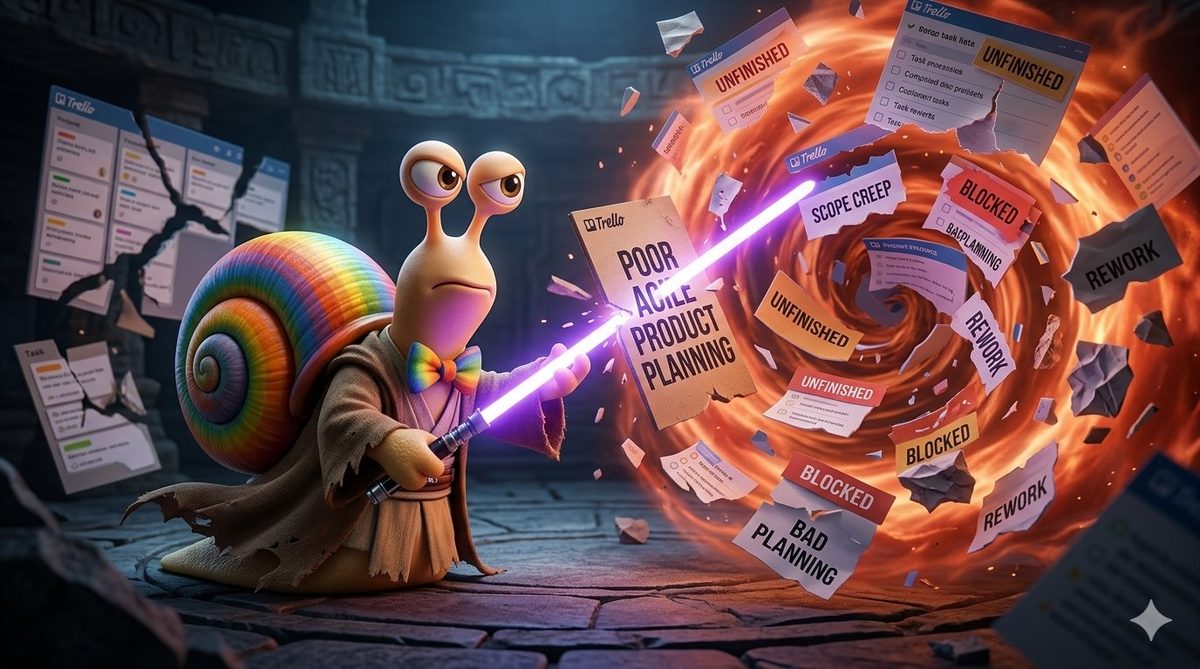
AI coding agents over-build by default. Unmanaged, they generate bloat, over-engineer simple requirements, and produce volume that looks like progress and lands as delivery debt. The methodology draws the line: scope each story tight enough for clean, atomic output, route work deliberately between human and agent, and clear tech debt at every step.
That's the closed loop. Not faster agile. The operating discipline that decides what gets built and by whom, so AI throughput doesn't become AI sprawl.
Plan. Generate.
Code. Sync. Repeat.
Four phases in a continuous loop. Telemetry flows from the coding agents back into planning, so every sprint plans better than the last.
Plan
Sprint goals, capacity, and story decomposition grounded in your codebase. The planning model accounts for both human and agent throughput.
Generate
Stories with full acceptance criteria, technical context, and dependency mapping. Written for agents to execute, not humans to interpret.
Code
Claude Code agents execute the specs. Telemetry, tokens, time, success rates, and blockers, flows back continuously, not in retrospect.
Sync
Board state updates in real time. Velocity recalibrates against actual throughput. The capacity model learns your team's signature. The next sprint plans against reality, not assumption.
SprintiQ Turbo Enterprise
SprintiQ Turbo Enterprise is the product brain: the orchestrator agent that sits between your humans and your AI developers, deciding what gets built, by whom, and in what sequence. It's the licensed counterpart to our open-source release, what development companies license to run their own AI-assisted builds, and what we run on every engagement.
Two consequences. The methodology you're hiring was refined across many engagements, not invented for yours. And the platform transfers: your team keeps using Turbo Enterprise after we're gone, on standard license terms.
Four architectural patterns.
Most engagements fit one of these patterns. Some span more than one.
Retrieval-augmented generation
Domain-specific RAG with custom embeddings, hybrid search, reranking, and citation-grade retrieval. Built for systems where wrong answers carry real consequences.
Multi-agent orchestration
Agentic workflows with specialized roles, tool use, memory management, and coordination protocols. The complex stuff: planning, decomposition, recovery from failure.
End-to-end AI products
Full systems with their own data layer, evaluation harness, deployment pipeline, and product UX. Yada, Earmark AG, and the mass tort fraud agents are examples.
Vibe-coding orchestration
Coordination layers above AI coding agents: sprint planning, story generation, bidirectional sync, velocity intelligence. The pattern we shipped as SprintiQ Turbo.
Fixed-scope builds. Principal on every sprint.
Typical engagements run 90 to 180 days on fixed scope. The principal is on every standup. We ship working software every two weeks. No offshore subcontracting, no junior delivery teams.
For longer engagements we move to a retainer once the core system ships: maintenance, evaluation, incremental capability. You receive production code in your repository, architecture docs written for the engineers who maintain it, evaluation suites that fail CI on regression, and knowledge-transfer sessions so your team owns the system after we leave.
Talk to Jeff.
For build engagements, scoping, and architectural reviews, email the principal directly.